Last checked: October 30, 2026. This page explains how to get medical records from a closed hospital in Pennsylvania. Independent guide, not affiliated with any hospital, records company or government agency. This is general information, not legal or medical advice.
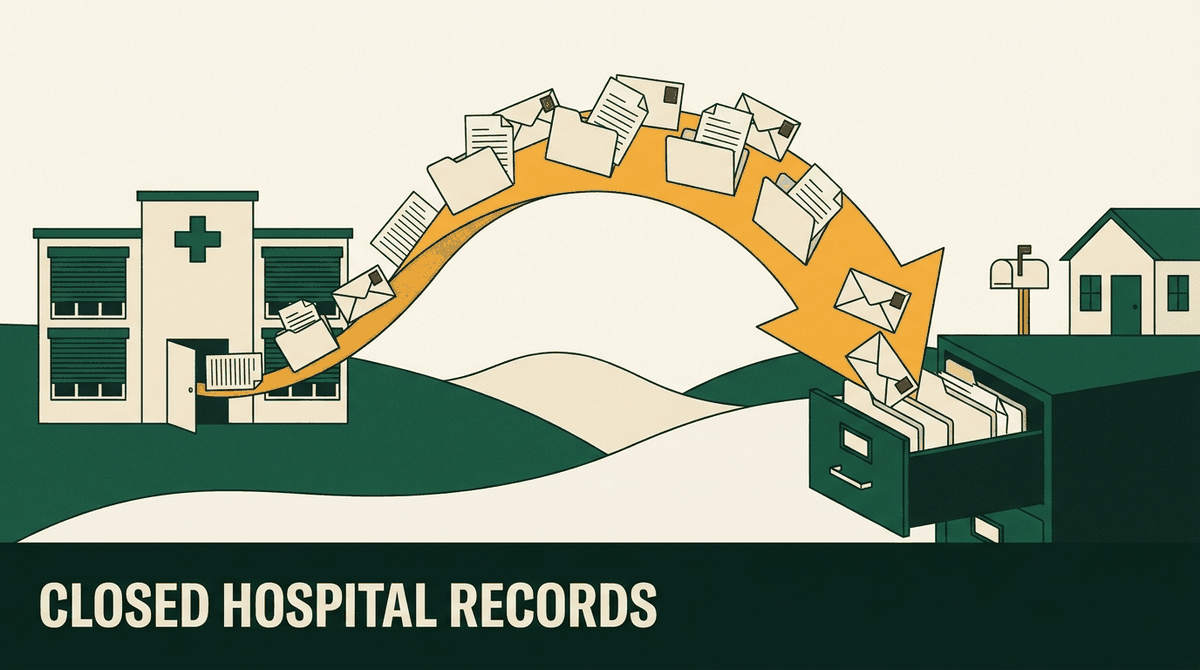
If you need to know how to get medical records from a closed hospital in Pennsylvania, start by finding the records custodian: the company or successor organization the hospital handed its files to when it shut down. Pennsylvania law requires a closing hospital to tell the state Department of Health where its records are stored and to keep them retrievable for at least five years after closing. For former Crozer patients, that custodian is Morgan Records Management, and our step-by-step Crozer records guide walks through the request itself.
The rest of this page covers the general process for any closed hospital in the state, what the rules say about how long records must be kept and what you can be charged, and the Crozer case as a worked example, since it is the largest hospital closure Delaware County has seen.
What Pennsylvania law says happens to records when a hospital closes
The key rule is 28 Pa. Code § 115.23, which governs how long hospitals keep medical records. It has three parts that matter here.
- Adults: records must be kept for at least 7 years after the patient’s discharge.
- Minors: records must be kept until the patient turns 18, and then for 7 more years (or as long as adult records are kept).
- Closure: a hospital that stops operating must tell the Department of Health where its records are stored. The records have to sit in a facility that offers retrieval services for at least 5 years after the closure date. Before they are destroyed, the hospital must give public notice, in a legal notice and a display ad in a general-circulation newspaper, so former patients can claim their own records.
That public-notice requirement is why destruction deadlines for closed hospitals tend to show up in local papers and county health pages. If a hospital you used closed more than five years ago, there is a real chance some records have already been destroyed after notice was given. Even so, it is still worth asking.
However, doctors’ offices follow a separate rule. Under 49 Pa. Code § 16.95, a physician must keep a patient’s record for at least 7 years from the last service, and a minor’s record until one year after the patient reaches majority. That rule has no closure section, so records from a hospital-owned practice can end up with a different custodian than the hospital’s inpatient chart.
Federal law does not fill the gap. The U.S. Department of Health and Human Services says plainly that the HIPAA Privacy Rule has no medical record retention requirement; state law decides how long records are kept. What HIPAA does give you is the right to see and copy whatever records still exist.
How to get medical records from a closed hospital: five steps
1. Find out who holds the records now
Most closed hospitals hand their charts to a commercial records-storage company, a successor health system that bought part of the business, or a court-supervised custodian in a bankruptcy. Try these in order:
- Search the hospital’s old website. Many keep a single page up after closing that names the custodian.
- Check the county health department’s website. In Delaware County, the county’s Prospect bankruptcy update page has been the most complete public source on Crozer records.
- Search local news for the hospital’s name plus “medical records.” Because of the public-notice rule, a destruction deadline usually makes the paper.
- Ask your current doctor’s office. Practices that took in a closed hospital’s patients often already know where to send requests.
- Contact the Pennsylvania Department of Health. The closure rule requires the hospital to tell the Department where records are stored. The Department itself does not hold hospital charts, though: its medical records request page says it does not possess all medical records in the state and mostly holds records from state health centers and reportable-disease files.
2. Work out which department has what you need
For example, large custodians often split a hospital’s files by department. A request for “my records” may get you only the general chart. Imaging files, pathology slides, behavioral health notes and itemized bills are frequently separate requests. Ask the custodian for its department list before you file, so you don’t wait 30 days and then discover you need to start again.
3. Send a written, signed request
Expect to provide your full name at the time of treatment (including a maiden or former name), date of birth, approximate dates of care, the address you had then, a copy of photo ID, and where to send the records. A parent or guardian can request a minor’s records. For a deceased patient, the custodian will usually ask for proof that you are the personal representative of the estate. An attorney can request with a HIPAA-compliant authorization you have signed.
4. Know the deadline the custodian has to meet
Under the HIPAA access rule, 45 CFR 164.524, a covered entity must act on your request within 30 days. It may take one extension of up to 30 more days, but only if it tells you in writing why it needs more time and when it will finish. So if you hear nothing after 30 days, call and ask for the status in writing.
5. Check the fee before you pay
When you ask for your own records, the fee is limited by HIPAA, not by Pennsylvania’s general copying-fee table. The federal rule allows only a reasonable, cost-based fee covering labor for copying, supplies such as a USB drive if you ask for one, postage, and a summary if you agreed to one in advance. The Pennsylvania Department of Health’s own medical record fees notice points out that search-and-retrieval charges cannot be passed on to you for your own records.
Pennsylvania medical record fees for 2026
The state’s fee table applies to requests from third parties, such as a lawyer or an insurer working on a claim, rather than to patients asking for their own records. It is still useful as a ceiling to compare against. These are the maximums effective January 1, 2026:
| Item | Maximum charge |
|---|---|
| Pages 1–20 | $2.00 per page |
| Pages 21–60 | $1.48 per page |
| Pages 61 and up | $0.52 per page |
| Microfilm copies | $2.95 per page |
| Search and retrieval (not allowed when you request your own record) | $29.61 |
| Records for a Social Security or needs-based benefits claim (flat fee) | $37.52 |
In addition, postage and shipping can be added. The table does not cover X-ray film or anything else that can’t be photocopied. The Department also states that it is not authorized to enforce these charges, so a dispute over a patient fee is a HIPAA question for the federal Office for Civil Rights.
Worked example: getting records from Crozer Health
Crozer-Chester Medical Center and Taylor Hospital closed in spring 2025, after Delaware County Memorial and Springfield had already closed their emergency rooms in 2022. Here is how the steps above work when you get medical records from a closed hospital like Crozer.
Who holds them: Morgan Records Management. Its Prospect Crozer custodian page says Prospect Crozer stopped providing patient care on May 1, 2025, and lists a medical records line at (833) 888-0061, Monday through Friday, 8 a.m. to 5 p.m. Eastern. Requests can take up to 30 days. The county says Prospect moved all Crozer requests to that single company in July 2025, which is why the old Crozer patient portal is no longer the route. Our page on the Crozer medical records phone number and Morgan contacts covers what to say when you call.
Departments, cost and the March 2027 deadline
Departments: Next, Morgan’s Crozer request page asks for one request form per department: General Medical Records, Radiology, Maternity, Endoscopy, Oncology, Mental Health, Billing, Pathology report and Pathology specimen. Records come on a USB drive by mail or as a download. For scans, see how to get Crozer X-ray, CT and MRI images.
Cost: Fortunately, in August 2025, under a court order, the Foundation for Delaware County committed $3 million to cover records costs for up to 43,000 patients, according to the county. Patients who paid before that arrangement can ask Morgan for a refund.
Deadline: The county reports that the bankruptcy court approved Prospect’s request to destroy remaining Crozer records, and that all Crozer Health System records will be destroyed after March 2, 2027, except certain imaging records ChristianaCare negotiated access to. Our breakdown of the March 2027 Crozer records deadline covers who should request first.
If you were treated at the old Drexel Hill hospital, our page on what happened to Delaware County Memorial Hospital explains where that campus stands. Delaware County’s Wellness Line, (484) 276-2100, can help with Crozer records questions.
Problems when you try to get medical records from a closed hospital
The custodian says it has no record of you. Ask it to search under every name you have used and a wider date range. Ask whether some departments (for example, a hospital-owned doctor’s office) went to a different custodian.
The records were destroyed. Ask for written confirmation of the destruction date. After that, rebuild what you can from other sources: your insurer’s claims history, pharmacy records, your current doctors’ notes, and any outside lab or imaging center that read your tests.
The fee seems too high. Ask for an itemized breakdown. For your own records, a search-and-retrieval fee should not appear. If you can’t resolve it, you can file a complaint with the HHS Office for Civil Rights at (866) 627-7748, the number the state’s fee notice lists.
You need them for a new doctor right now. Instead of waiting for a copy yourself, ask the custodian to send them directly to your new provider. Your new doctor’s office can often make the request for you, which saves a step.
Frequently asked questions
How long does a closed hospital in Pennsylvania have to keep records?
The records must be stored somewhere that offers retrieval for at least 5 years after the hospital closes, and the general rule is 7 years after discharge for adults. Before destruction, the hospital has to give public notice so patients can claim their files.
Does the Pennsylvania Department of Health have my hospital records?
Usually not. The Department says it does not hold most patients’ records. A closing hospital must tell the Department where its records went, so the Department can be a lead for finding the custodian, but the request itself goes to the custodian.
Can I get a closed hospital’s records for a parent who has died?
Yes, if you are the personal representative, typically the executor or administrator of the estate. Expect to send a death certificate and the court paperwork naming you.
How long does it take to get medical records from a closed hospital?
Up to 30 days under HIPAA, with one possible 30-day extension if the custodian explains the delay in writing. Morgan says Crozer requests can take up to 30 days.
Crozer patients: the county says remaining Crozer records will be destroyed after March 2, 2027. If you have not requested yours, start with how to request your Crozer medical records.
An independent guide. Crozer Health Center Guide is not affiliated with Crozer Health, Prospect Medical, Main Line Health, Trinity Health or any hospital, and nothing here is medical advice. In an emergency, call 911. For a mental health crisis, call or text 988.
Open ERs in Delaware County · Crozer medical records · All guides